snappyHexMesh is a fully parallel, split hex, mesh generator that guarantees a minimum mesh quality. Controlled using OpenFOAM dictionaries, it is particularly well suited to batch driven operation.
Key features:
stl, obj, vtksnappyHexMesh: Quick reference
The overall meshing process is summarised by the figure below:
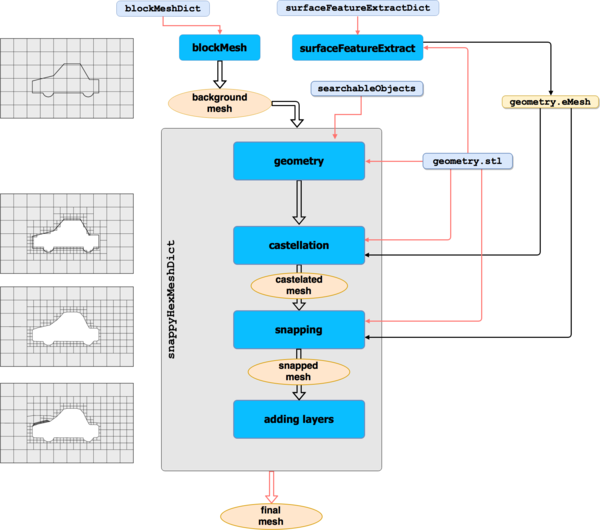
This includes:
Evolution of the snappy mesh for the iglooWithFridges tutorial is shown below:
Meshing controls are set in the snappyHexMeshDict located in the case system directory. This has five main sections, described by the following:
The command snappyHexMesh executes the meshing process. Adding the -help option, i.e.
snappyHexMesh -help
returns the list of available options
Usage: snappyHexMesh [OPTIONS]
Options:
  -case <dir>       Specify case directory to use (instead of the cwd)
  -checkGeometry    Check all surface geometry for quality
  -decomposeParDict <file>
                    Use specified file for decomposePar dictionary
  -dict <file>      Use alternative snappyHexMeshDict
  -dry-run          Check case set-up only using a single time step
  -outFile <file>   Name of the file to save the simplified surface to
  -overwrite        Overwrite existing mesh/results files
  -parallel         Run in parallel
  -patches <(patch0 .. patchN)>
                    Only triangulate selected patches (wildcards supported)
  -profiling        Activate application-level profiling
  -region <name>    Specify alternative mesh region
  -surfaceSimplify <boundBox>
                    Simplify the surface using snappyHexMesh starting from a
                    boundBox
  -doc              Display documentation in browser
  -help             Display short help and exit
  -help-compat      Display compatibility options and exit
  -help-full        Display full help and exit

Automatic split hex mesher. Refines and snaps to surface

Using: OpenFOAM-v1906 (1906) (see www.OpenFOAM.com)
Build: v1906
Arch:  LSB;label=32;scalar=64
By default, each of snappyHexMesh's phases, i.e castellation, snapping and layer addition will write a complete mesh in time folders. This behaviour can be suppressed by using the option
snappyHexMesh `-overwrite`
| Would you like to suggest an improvement to this page? | Create an issue |
Copyright © 2016-2017 OpenCFD Ltd.
Licensed under the Creative Commons License BY-NC-ND 
 1.8.17